

A while ago, I enrolled in an MSc program in Business Management. As an electrical engineer and later as a software engineer, I never really got the chance to study social sciences properly before. With the years of working in large enterprises, I saw my fair share of crap that made me really wonder: why do people "up there" take such dumb decisions? I got really interested into management, economics, leadership and these things. And a year ago, I thought let's make this relationship official. So I applied for that masters program.
As you might expect for an MSc program in management, it has a lot of written assignments as the main way of evaluation. Reflection papers, research papers, market analysis papers, and many more. Initially I insisted on writing everything on my own. I said to myself: I am paying for that goddamned program to actually learn something. I can't just let AI do it.
However, as Mike Tyson said: Everyone has a plan until they get punched with a deadline. So a couple of them slipped from me and I had to outsource them to AI. Not entirely of course, but at least I wasn't forced to endure that excruciating pain that I experience when I try to squeeze my brain to get things out of it in a way that other people can read.
That pain, is exactly what this article is about.
How Knowledge is Formed in the Human Brain
In human learning literature, and increasingly now in the field of AI, researchers use the term Distillation or Knowledge Distillation to express how humans, or AI, learn. In chemistry, the term means the process that purifies or separates liquids by heating them into a vapor and cooling that vapor back into a liquid. Think about getting pure water from sea water here.
In the human brain, a very similar process is continuously running to generate the actual knowledge, or wisdom, or whatever you call that stuff that you get out of the books that you read, the papers you study, the discussions you have with people in a given field, and other "knowledge-seeking" activities you do in general. Your brain takes all of that, digests it, and hopefully gets you something useful at the end of it.
Believing that a picture is worth a thousand words, I tried to think of a graph that illustrates my point, and this is what I came up with.
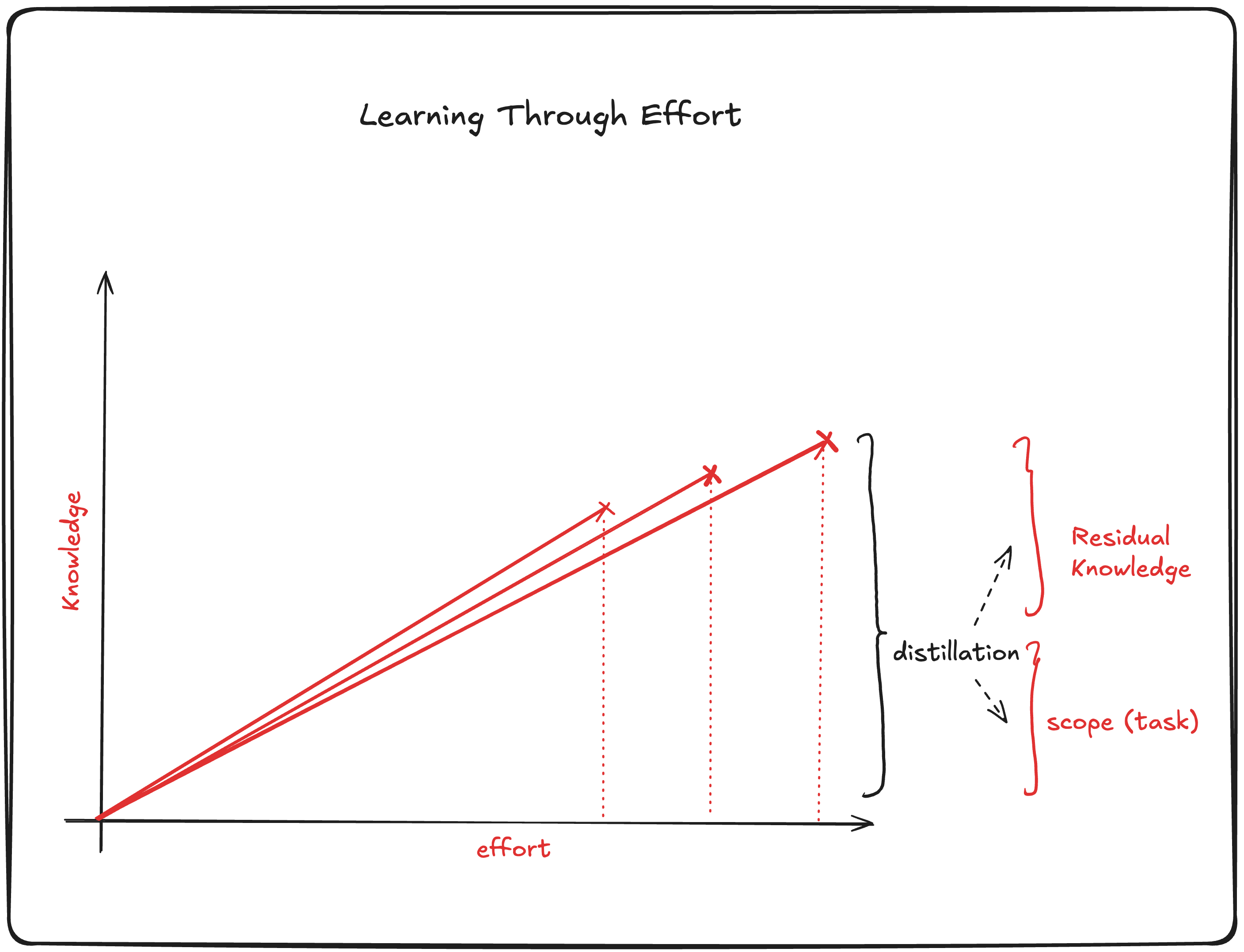
For this graph, assume you use AI only as a better search engine, not as a co-author.
Now imagine working on a task of some sort and within a given scope — let's say a research paper. What do you do? In the old days, before AI, you would typically begin by analyzing the existing literature to identify a specific gap, formulate a clear hypothesis or research question to address it. From there, you would gather some evidence through data collection or synthesis, organize your findings into a logical framework, and draft a manuscript to clearly articulate your contribution to the field.
If you do this process well enough, you will be exposed to huge amounts of data and research information along the way that you'll need to constantly organize into a coherent hierarchy, cross-reference against other sources, and translate from abstract concepts into concrete language that you can later use. Anyone who has done this before knows how demanding it can be and how it feels sometimes like your head is burning through it.
This process is what learning is. This process is what breeds actual, lasting knowledge at the end.
How Does AI Change This?
For this section, I am talking about a specific style of AI use: largely entrusting the main mental synthesis process and later the writing to AI. So, you have the idea, and you have the rough argument more or less in your mind, but you don't do the actual work of reading and studying the material yourself, and later the writing and re-writing of every passage in that paper. Instead, you give whatever AI tool the broad guidelines and rough idea and you let it cook and then you review at the end.
This style, in my experience, doesn't let you actually learn what you are trying to learn. At best, some of that material will latch to some neurons in your brain, but it would be in no way comparable to the other style we mentioned earlier. Let's look at this graph.
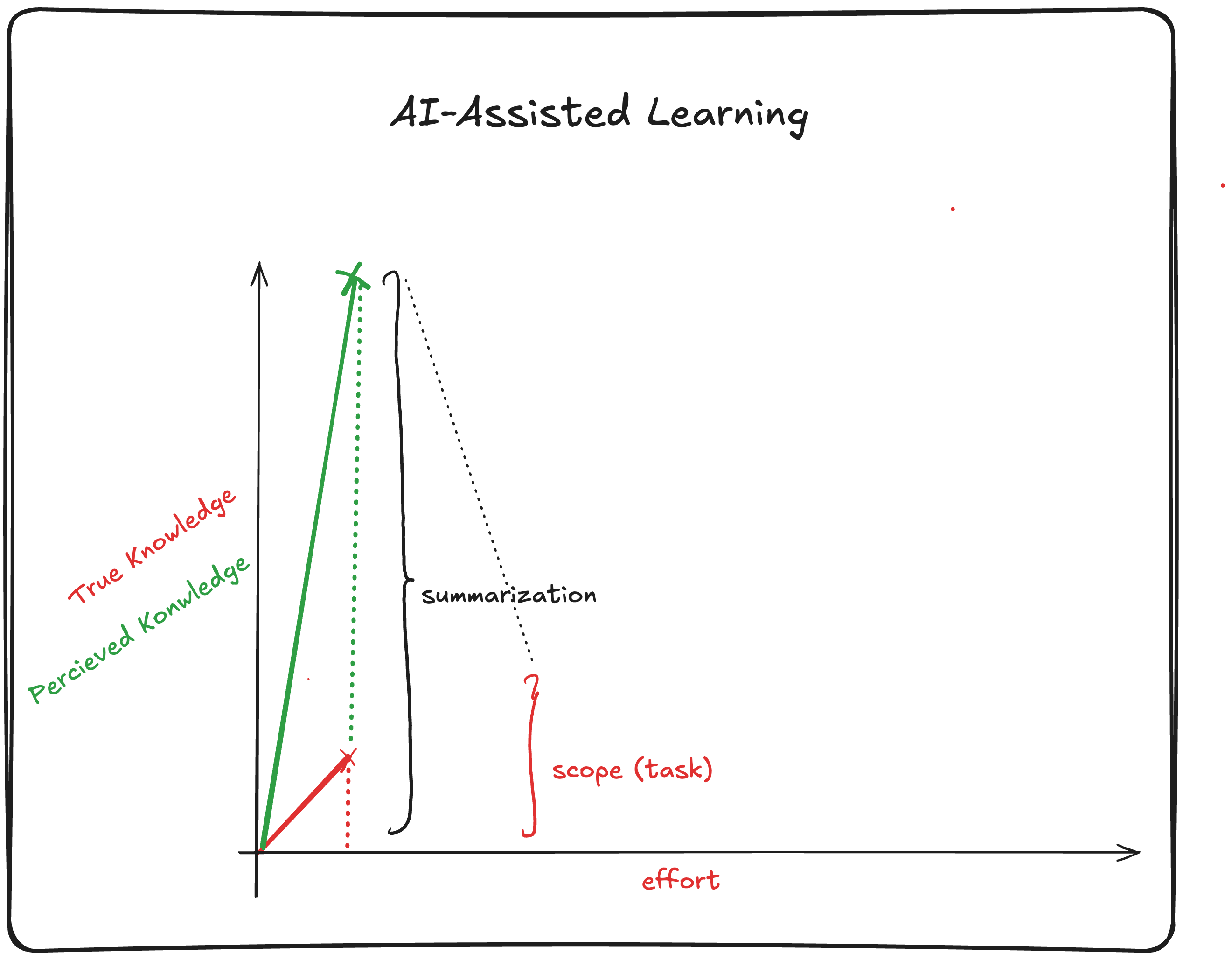
What I would like to highlight here is the difference between the "true" knowledge acquired or "distilled" from a given activity or task, and the perceived knowledge that people might report after doing such work with the help of AI. Perceived knowledge is very tricky. It gives you the illusion that you have actually covered this topic, or that you actually did the research. But in reality, you didn't.
Because the text that you "review" at the end makes sense while you are reading it, your brain tricks you into believing you could have generated that thought. However, if asked to explain it deeply 48 hours later without looking at the text, the retrieval pathways are often too faint to access.
Collaborate, Don't Outsource
What I am trying to say here is that learning, by definition, is an activity that you have to endure to get its benefits. Much like sports, you have to get sweaty to stay in shape.
There is no shortcut known for this.
What we can do, though, to get the benefits of AI while, at the same time, not conceding our thinking abilities or suffering damaging effects on our analytical skills and in some cases complete brain rot, is to collaborate with AI.
I found this strategy to be working quite well. Let me elaborate…
Let's take the research paper again as the example. I start with an idea in mind, I do some research, I read the course material, I skim some other material that seems relevant, I listen to some material on the topic if available. After all of that, I have a rough idea in mind on what I need to do for that paper, but not really how to start.
I use Claude, so I give it this prompt:
I need you to work with me on Topic X. Here is my initial thought on the topic: <your thought>. I need you to collaborate with me on this. We need to start looking into <1>, <2>, <3>. Don't assume anything, and you are encouraged to say I don't know and ask any question you would like to ask.
This prompt takes the session with AI to a completely different place. It reduces hallucinations by a lot and increases the productivity of the session. Claude feels very direct and honest with me — it reports back figures and citations it is not sure about and tells me: "please double check this to make sure I am not hallucinating". It was truly mind boggling to me the first time I tried this.
After you finish the collaboration session, you tell Claude to compile whatever you think is important in an md file. That md file becomes the starting point for the actual paper. You read it and you start thinking how to start writing the damn thing.
Writing is the Most Important Thing
It really is. You can't outsource this. You have to do it. The writing process works on so many levels that are extremely crucial for the distillation process and overall macro-cognition as we said earlier.
Only by writing do you compress all the scattered information around your brain, organize your thoughts, and extract neat new information that you put in your brain's drawers. Again, there is unfortunately no shortcut for this process.
There is Light at the End of the Tunnel
As with anything, practice makes perfect. This painful process gets easier with time and you get better at it. The first time I wrote a full paper without any AI usage, it felt like I was being tortured. The second time, less so. The third time, I actually enjoyed it. That's the compound interest of skill, it doesn't feel like much at first, but it accumulates.