

Most of us have been in meetings that feel like a waste of time. In today's fast-paced work environment, it's common for most of your day to be filled with meetings. Some of them are justified, some of them definitely aren't. Yet, the majority of both are often longer than they should, and are generally poorly structured.
The signs of such meetings are obvious and you will feel them. Usually, they have one or all of the following symptoms:
- Long introduction from the organizer about the topic. This implies that either the invite didn't mention what the meeting is about, or the topic itself isn't well understood to the participants.
- The majority of the participants are disengaged from the conversation.
- You notice that the majority will start switching off their cameras and muting themselves, responding to Slack messages or emails.
- Most of the discussion is confined between 2 or 3 participants.
- Someone asks at the end of the meeting, "So what should we do now?" — suggesting that either the expected outcome wasn't clear, wasn't well communicated, or that participants were distracted and only wanted a quick summary of what was decided.
Such meetings always reminded me of that sleep glasses meme on Reddit where a student seemingly printed a pair of eyes on paper and fixed it on glasses to appear awake while being asleep in the classroom.
While such action could be okay for a student in a classroom — at the end of the day, this was their time (and maybe money if the degree was paid) being wasted. But it is absolutely not okay to do that in your work life. Because it isn't only your time that you are wasting, it is everyone else's time and company resources.
If similar situations happen frequently in your organization, I believe this is a strong sign that you run — or run into — a lot of ineffective meetings.
Problem definition
Someone might ask, but why is this bad? At the end of the day, a topic was opened for discussion and the interested people were involved — other people might not have had something to contribute.
Well, not really. The main point of a meeting is to have a group of people with utmost focus discussing and collaborating on a common goal to reach an ultimate outcome. Having the majority be silent participants that don't contribute anything won't help you reach your meeting's goal.
Effective meetings make you feel that the time you spent on a given topic has been productive and that you have made quite some progress. They boost your morale and motivate you to continue working. They feel like a breath of fresh air to our — mostly — dull work life.
But before going into what makes a meeting effective and worth its time, I need to point out a major mental bias that many of us have.
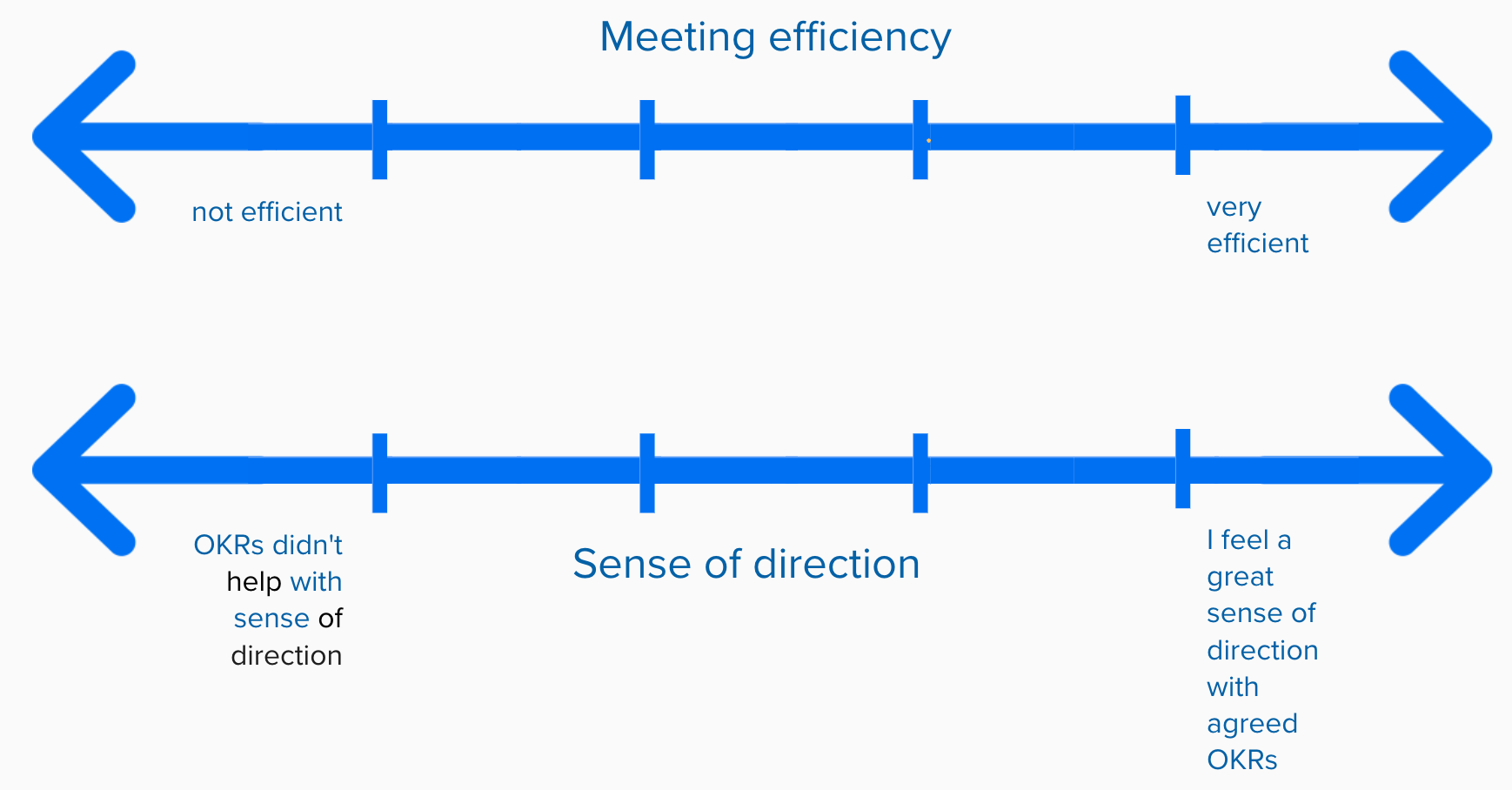
Side note: One thing you can easily do to track this is to have 1 minute at the end of your meetings to survey everyone on how valuable that meeting was to them on a given scale, and if their sense of direction on the topic has improved.
Potential alternatives you should consider
It is easy to think that every discussion and every issue needs to be addressed in a meeting. The stereotypical image of a corporate — or startup — employee running with the laptop in their hands to some meeting room fuels this bias.
I would argue that the vast majority of today's work meetings could either be:
- A simple thread exchange
- A well-written decision memo
- An ADR if you are a technical person
For instance, Amazon is widely known for its writing culture that was initiated by Jeff Bezos in early 2004 to refine product and business ideas shared within the company. These forms of asynchronous communication might seem time-consuming initially, but they are exponentially more efficient and productive once you get used to them.
Making the initiator write a decision memo — or a six-page narrative as in Amazon's case — and share it with the participants makes sure that everyone has the full context of the issue at hand, to only then start the meeting to discuss the real contention points.
Effective meetings recipe
Assuming you either did what I suggested and wanted a meeting afterwards to discuss a memo or ADR, or you had a different topic that only needed a meeting directly, I suggest the following points:
-
Clear objective: A meeting should have a clear objective that the attendees are there to address. This goal should be written somewhere — either using one of the approaches I suggested earlier, or at least in the meeting invitation.
-
Only the right attendees: It is common to have the urge to invite more people than you actually need to make sure all concerned parties are in the same room. However, this tends to be distracting and pushes the discussion to spiral between different people that aren't on the same page. Be conservative and invite only the people that absolutely need to be there.
-
Attendees have acquainted themselves with the prep material: The attendees need to prepare by reading any prep material shared by the organizer. This saves a substantial chunk of the meeting's time as the organizer doesn't have to introduce the topic to make sure everyone is up to speed.
-
Discussion is focused on the meeting's objective: This almost only happens if the previous points have been achieved. It is the organizer's responsibility to keep the discussion focused and move off-tangent discussions to another suitable place.
-
Clear outcome is defined: A good meeting should predefine the expected optimal outcome and document it. That outcome could be some decision that needs to be made or an agreement reached — something needs to serve as the success criteria for that meeting.
The path forward
The Japanese term Kaizen in business studies refers to the consistent effort of working on small improvements that aim to eliminate Muda — another Japanese term referring to waste. Waste is a key concept in lean management that refers to any activity that consumes time, effort, or any valuable resource without bringing equivalent value.
If you look again at the points we discussed, you will notice that all of them address some sort of wasted activity in the meeting slot — time wasted for an introduction that could've been avoided if the attendee read the prep material, or time wasted on a discussion of a side point unrelated to the meeting objective.
All of this time waste is also money waste, as — surprisingly? — these people are paid to be in these meetings. One interesting idea here is what Shopify did to estimate the cost of a given meeting based on the number of people invited and the duration to assess the financial impact of meetings in the organization.
So, try to think about the meetings you have in your org, and analyze them. Write down what aspects of waste are present and what could be the smallest step you can do to change this in the right direction, and iterate.
If you are in an agile team, retrospectives are a suitable slot to kick off such a discussion to bring everyone onboard and collaborate together on a plan to address your specific issues.
I would like to hear what your experience with meetings is in your organization, and how you make sure you have good and effective meetings. Feel free to share your thoughts and ideas.