
This year's job satisfaction report in Germany found that 75% of people are satisfied with their current job, a number that is 8 percentage points lower than last year. The same report also found that 41% of workers are open to changing jobs, and some are already planning their next move.
While this might be good news for recruiters, the glaring finding here is that satisfaction no longer seems to be a reliable indicator of retention. Higher compensation, flexibility in workspace and time, and personal development are the top drivers cited by employees looking to move on.
To make sense of this, let's take a short detour.
Turnover Drivers vs. Retention Drivers
In 1959, Frederick Herzberg proposed what became one of the most cited frameworks in organizational psychology: the Motivation-Hygiene Theory, also known as the Two-Factor Theory. He argued that there are two distinct sets of workplace factors that shape employee attitudes: one set called Hygiene Factors, and the other Motivators.
The first set is extrinsic to the work itself. Their absence causes dissatisfaction, but their presence only brings someone to a neutral state: no dissatisfaction, but no active motivation either. The name "hygiene factors" captures the idea well: just like personal hygiene doesn't make you attractive, it just prevents you from being repellent.
The second set is intrinsic to the work itself. These are the true drivers of engagement and meaning. They determine whether you wake up energized and curious about the day ahead, or already counting down the hours until it's over.
Well-functioning organizations need to balance both. Hygiene factors are managed so that no one is sitting in quiet resentment about their conditions. Motivators are cultivated so that the organization develops the internal drive that makes people go above and beyond, not because they were told to, but because they want to.
Herzberg's Motivators and Hygiene Factors
% frequency as cause of satisfaction vs. dissatisfaction · Herzberg, The Motivation to Work (1959)
Bold labels = motivators · Muted labels = hygiene factors
Applying the Theory to the Job Report
Looking at the chart through the lens of the satisfaction report, something becomes clear. The top cited reasons for wanting to leave: salary, working conditions, work-life balance, all sit squarely in the hygiene column. They are, by Herzberg's framework, dissatisfaction drivers, not motivation drivers.
This is not a contradiction. It explains exactly why you can have 75% of people reporting satisfaction while 41% are still considering leaving: the hygiene factors are adequate enough that people aren't miserable, but the motivators are absent, so there is nothing pulling them to stay.
The salary question is worth pausing on, because it sits in a grey zone. Money can function as a motivator, but only up to a point. Once compensation crosses the threshold of feeling fair and sufficient, it stops being a primary driver and reverts to being a hygiene factor. I don't think I need to make a hard case for this. One look at any of the billionaires running large companies makes the point on its own. Jeff Bezos is not getting out of bed every morning driven by the prospect of a larger year-end bonus.
So it makes sense for these factors to be the leading reasons for why 41% of the employees feel so unhappy within their current role that they start to actively seek a new job. And, I think it is safe to assume that these employees are not particularly motivated either. They are, most probably, doing their work in the least enthusiastic way and hoping they can push through it until they find something better.
When you hear the word "motivation" in a work context, what does it actually mean to you?
To me, it is that psychological force that lets you do your best work every day and feel energized while you do it. It is what makes you wake up genuinely curious about what the day holds, not dreading it, but actually looking forward to it.
Motivating with KITA
So how do you actually create that in people? Or more generally, how do you get someone to move and do that thing you want them to do?
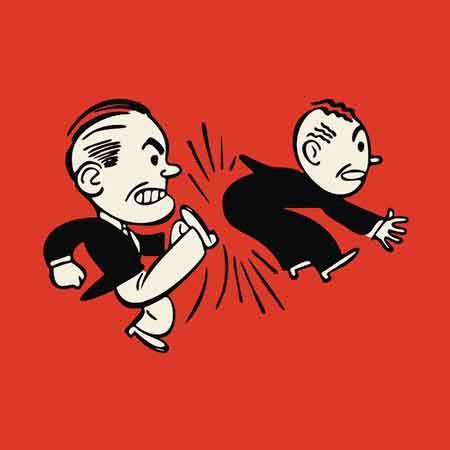
Historically, the answer was what Herzberg called Negative Physical KITA: literally, a kick in the ass. The most direct way to get someone to do something is to threaten them. Since this is a bit hard to do now in our current workplaces and probably will get you in a bit of trouble, the least of which is to be kicked back, managers graduated to something more HR-friendly: Negative Psychological KITA. This opened the door to passive aggression, micromanagement, and all the subtle techniques a manager can use to administer just enough fear to keep people compliant, while staying above it all and dismissing any complaints as paranoia.
But Herzberg's sharpest observation was reserved for Positive KITA, which is what most organizations today call "motivation." Raises, bonuses, perks, free lunches. All of it.
His test is simple: ask who is actually motivated in the transaction. When a manager offers a reward to get an employee to perform, it is the manager who wants the outcome and is driving the exchange. The employee is just responding to a stimulus, the same way a dog moves toward a biscuit. The moment the biscuit disappears, the bonus cycle ends, the perk goes away, the movement stops. This is why organizations that rely on incentives are trapped in an escalation loop: each reward loses its pull once people get used to it, so you need a bigger one next time.
The deeper problem with Positive KITA is that no matter how generous, it only ever addresses dissatisfaction. It cannot produce the genuine engagement that comes from the work itself: the sense of achievement, growth, and ownership that makes someone want to do the job well regardless of what they're being paid.
"The opposite of job dissatisfaction is not job satisfaction, but no job dissatisfaction." — Frederick Herzberg
Motivating the Right Way
In his book Drive, Daniel Pink argues that true intrinsic motivation rests on three elements: Autonomy, Mastery, and Purpose. These map closely to what Herzberg called motivators: achievement, recognition, the work itself, responsibility, advancement. When these are genuinely embedded in how work is designed and done, people aren't just compliant. They're engaged, creative, and driven to do good work because the work itself demands it.
Autonomy is the desire to self-direct. Pink's argument is that humans are naturally wired this way, but traditional management systematically trains it out of people, turning them into passive followers. Real autonomy operates across four dimensions he calls the 4 Ts:
- Task — having a say in what you work on
- Time — control over when you work, with focus on results rather than presence
- Technique — freedom in how you accomplish a goal, rather than being micromanaged on the method
- Team — some choice over who you collaborate with
Mastery is the urge to keep getting better at something that matters. Pink defines it through three laws: mastery is a mindset (it requires believing your abilities are developable, not fixed), mastery is a pain (it demands deliberate effort and the willingness to push through plateaus), and mastery is an asymptote (you can approach it but never fully reach it, and that endless pursuit is precisely what makes it satisfying).
Purpose provides the context for the other two. It answers the question: why does this matter? Without it, autonomy and mastery are just sophisticated tools in a vacuum. High performers are motivated when their work connects to something larger than the task at hand, when they can see how what they do contributes to something meaningful, whether to the people they serve, the product they're building, or the world they're operating in.
Closing
Motivation is a fuzzy state. With enough of it, directed at the right things, it lets you move mountains. Without it, work becomes a Sisyphean loop: rolling a boulder up a steep hill, watching it slide back down just as you reach the top, and starting over the next morning.
Work doesn't have to be that. Organizations have a real and underused set of options for designing environments where people actually want to show up, where the conditions are right, the work is meaningful, and people feel like they belong. That's not a utopian idea. It's a design problem. And it has known solutions.
Sources
- Herzberg, F. (1968). One More Time: How Do You Motivate Employees? Harvard Business Review, January 2003 reprint (R0301F).
- Pink, D. H. (2009). Drive: The Surprising Truth About What Motivates Us. Riverhead Books.
- Wan Yusoff, W. F., Tan, S. K., & Idris, M. T. M. (2013). Herzberg's Two Factors Theory on Work Motivation: Does Its Work for Today's Environment? Global Journal of Commerce & Management Perspective, 2(5), 18–22.