

Throughout history, new technologies come into existence in the form of a "substitution event": a new discovery, a new regulation, the successful launch of a product or a service that triggers a fundamental change in how people think about the future. Consequently, people scramble to answer one question: how can we make use of this thing? How can we make a business of it?
This initiates what is called the Product Innovation Cycle, where companies and startups start developing products and ideas based on the new technology. Over time, these products hit the market. Some flop and fade out; some prove their fitness and gain acceptance. At that point the competition tends to move from being innovative and creative to being a fight over price and features, all built on the dominant design that proved itself.
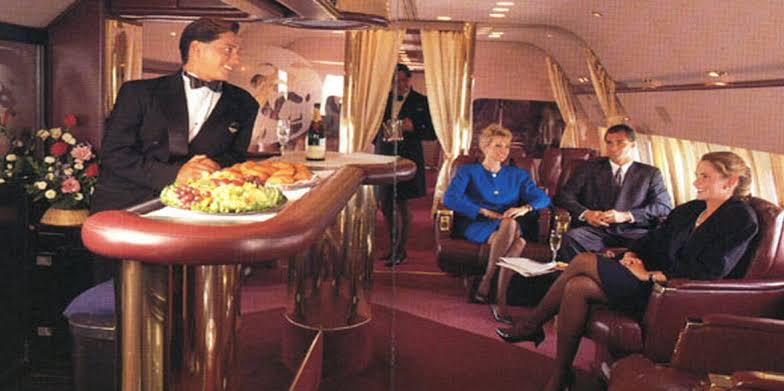
The clearest example of this dichotomy is the transformation the aviation industry went through between the 70s and the 90s. Once the idea and the designs for how air travel could be conducted were established, and once the service had proven worthy and crucial for everyone, the competition moved onto the dominant standard design and how cost-efficient it could be made. And that is how we ended up with the current abysmal economy seat that makes you weep when you see how it used to be back then.
The Negative Example
From the early 1950s until the late 70s, it was known as the "Golden Age of Air Travel." Airlines competed on how innovative, creative, and luxurious they could be, and on how many features they could pack into the price of a flight: gourmet meals, piano lounges on the upper decks, generous legroom, pristine service. All of it in service of maintaining and expanding a loyal, happy customer base.
However, lo and behold, on February 6, 1978, the US Airline Deregulation Act hit the market.
Overnight, the federal law signed by President Jimmy Carter ended government control over airline fares, routes, and new market entries. It was no longer a competition over how many impressive things you could pack into a fixed-price ticket; it was an open competition that naturally gravitated toward a price war. Ultimately, all the major airlines of the era failed to withstand the shift. When the market settled on a dominant design, where the airplane became a commoditized, cost-optimized bus in the sky, their high cost structures, inflexible fleets, and premium brand identities turned from assets into fatal liabilities.
What Is Organizational Ambidexterity
This expression has a lot of definitions. In my own words, it is how to be a schizophrenic organization: one that manages to balance two contradictory efforts at the same time: Exploration and Exploitation.
It is how to nurture a culture and a workforce that maintains and enforces congruence among strategy, structure, and people, while simultaneously preparing for the inevitable revolutions demanded by the discontinuous substitution events that can occur at any given moment. In the context of the aviation example, the old airlines were only good at the Exploration part of the equation. When the market shifted to an Exploitation model, these firms didn't have what it took to succeed.
"To remain successful over long periods, managers and organizations must be ambidextrous, able to implement both incremental and revolutionary change."
Michael L. Tushman & Charles A. O'Reilly III, Ambidextrous Organizations: Managing Evolutionary and Revolutionary Change
A Positive Example
Google dominates the search market with a share of more than 90%. This is its main source of revenue: more search means more traffic means more ads. People tend to forget that Google is basically an ad company masquerading inside a tech bubble. More than 80% of Alphabet's (Google's parent company) total income comes directly from ads on Google Ads, Search, YouTube, and Gmail.
So this is the golden goose that maintains the continuous flow of golden eggs. The last thing any executive there would want to do is mess with it, right? Well, not really. As we alluded to earlier, in the presence of a major discontinuous substitution event, it is near fatal to think that way. It becomes crucial to put on your ambidextrous hat and see the situation differently.
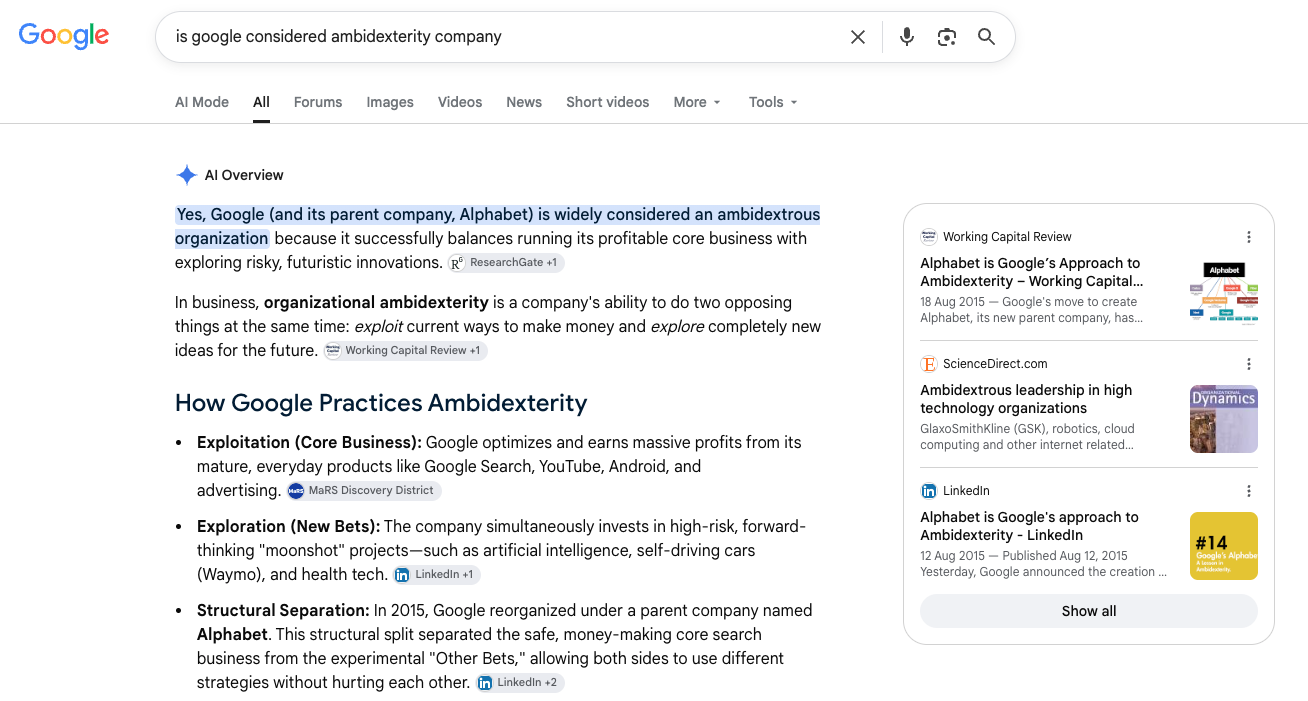
The AI Overview you now see at the top of the results page is something that, on paper, shouldn't benefit Google in any way, shape, or form. It prevents you, the person doing the search, from clicking through to the websites that offer a potential answer to your query. That means less traffic to those websites, which means fewer ads they can sell, which means less revenue flowing through the ecosystem Google sits on top of. So why would anyone do that?
The answer is that sometimes you need to eat yourself before someone else eats you. Sometimes a business has to cannibalize its own profits with a new venture before a competitor gets to that profit first.
I think this is a case study in being an ambidextrous organization that balances the two impulses at once: exploiting a search-and-ads machine that still prints money, while exploring an AI-native way of answering questions that threatens the very traffic that machine depends on. Google could have defended the golden goose and waited. Instead it chose to compete with itself, betting that a smaller slice of a market it still owns beats a large slice of a market that OpenAI, Perplexity, and the rest are busy redrawing. That is exploration funded by exploitation, the whole point of ambidexterity. The old airlines never made that move. Google made it against its own core business, on purpose.
Ambidexterity Is a Structure, Not a Mood
Here is the part most people get wrong, and it is worth being honest about it. "Cannibalize yourself before someone else does" sounds like a decision, a moment of courage in a boardroom. It isn't. If it were just a matter of will, the old airlines had plenty of smart, brave executives, and they still went under. The reason is that the exploring effort, if you leave it inside the core business, gets strangled by the very machine that makes the core successful.
Think about it from the inside. The people running Search are measured on traffic and ad revenue. Ask that same team to nurture a feature whose entire point is to send less traffic to the pages that carry ads, and you are asking them to work against their own targets, their own bonuses, their own instincts. They won't sabotage it out of malice. They will simply, rationally, starve it. Every dollar and every engineer has a more predictable use in the thing that already works. This is the exploitation bias, and it is structural, not personal.
So the real answer to "how do you do this without eating yourself alive" is organizational, not motivational. You separate the exploring venture from the exploiting core. You give it its own P&L, its own metrics, its own culture and cadence, and you protect it from being judged by the core's rules. The metaphor I like is the speedboat and the ocean liner: the ocean liner keeps carrying the cargo that pays the bills, while a small, fast speedboat is free to go somewhere new, borrowing the liner's engineering without inheriting its cost structure or its incentives. The two only meet at the very top, where a leader who owns both can referee the fights over money and attention that they will inevitably have.
That is the uncomfortable footnote to the Google example. Running AI Overviews inside core Search is the harder version of this, because it puts the explorer and the exploiter in the same room fighting over the same metrics. It can work, but only if the leadership actively shields the new thing from the old thing's scorecard. Ambidexterity, done properly, is less about being brave and more about building a house with two rooms that don't have to agree.
The Success Syndrome: When Past Success Becomes Fatal
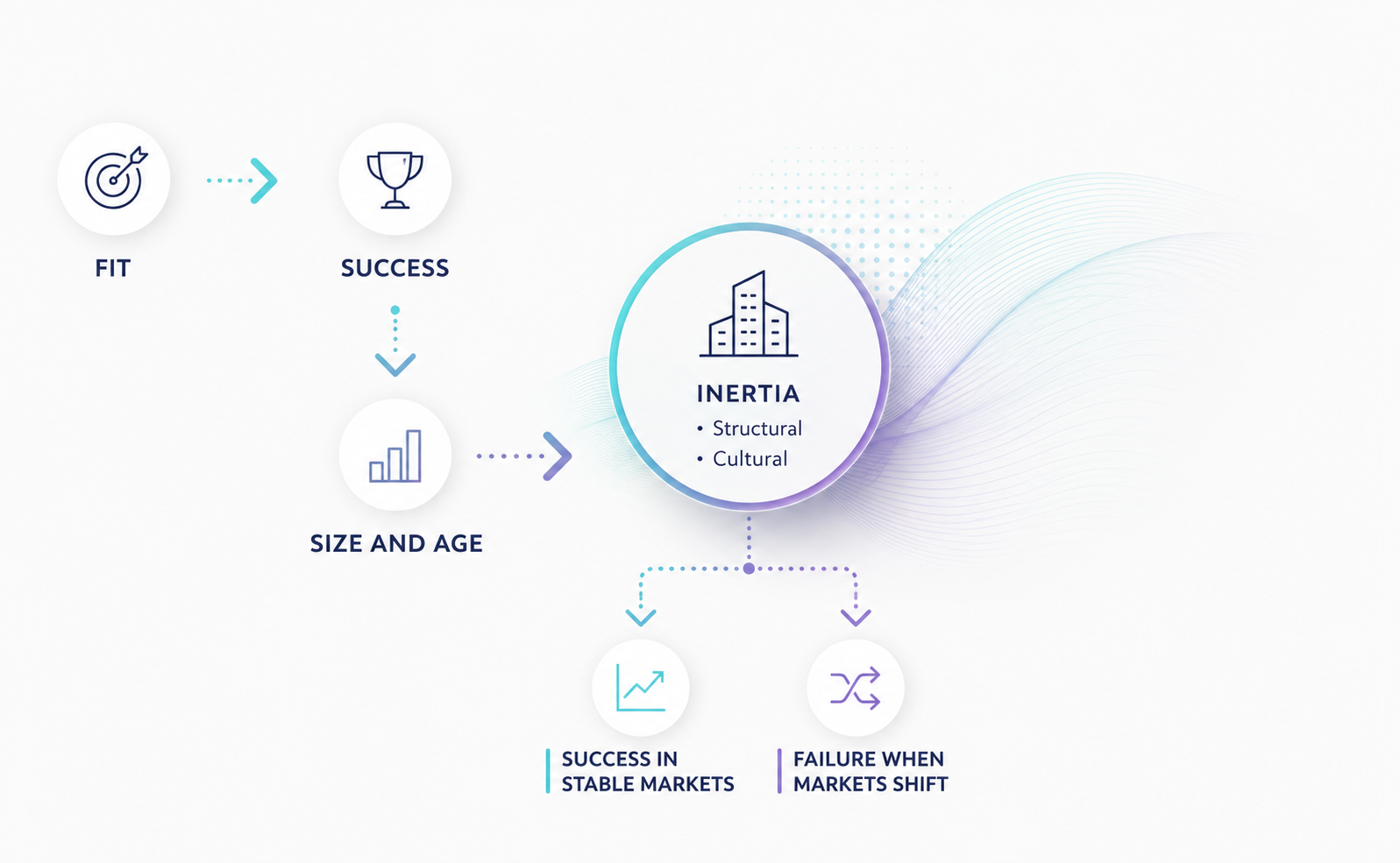
Executives, managers, and the architects of any organization are responsible for designing their units to best fit their strategic challenges. Internal congruence among strategy, structure, culture, and people drives short-term performance.
The things organizations cherish, such as a loose functional structure, strong internal-promotion practices, a positive culture, and engineering-led decision making, all work together to produce a highly congruent system and, in turn, a highly successful organization. But in the face of fundamental competitive or technological change, those same things can become the recipe for failure.
Research here differentiates between two types of inertia:
- Structural inertia. As successful companies grow larger, their interconnected systems, procedures, and formal structures become increasingly complex. This creates structural friction, making non-incremental, radical change slow, costly, and difficult to execute.
- Cultural inertia. As organizations age and achieve success, operational lessons solidify into unwritten norms, values, and stories. While that culture simplifies coordination in stable times, it breeds complacency and organizational arrogance when the market shifts.
So the very alignment, systems, and strong culture that guarantee success in stable environments directly cause failure during major competitive or technological shifts.
Evolutionary change optimizes short-term performance, but it quietly builds up "organizational high cholesterol," that is, structural and cultural inertia. When a market undergoes discontinuous change, incremental tweaking fails, and survival requires a radical, revolutionary transformation of strategy, structure, and culture.
Summary
Executives must be prepared to cannibalize their own business at times of industry transition. While this is easy in concept, these organizational transitions are quite difficult in practice. Success brings with it inertia and dynamic conservatism. Four hundred years ago, Niccolò Machiavelli noted:
"There is no more delicate matter to take in hand, nor more dangerous to conduct, nor more doubtful in its success, than to be a leader in the introduction of changes. For he who innovates will have for enemies all those who are well off under the old order of things, and only lukewarm supporters in those who might be better off under the new."
While there are clear benefits to proactive change, only a small minority of farsighted firms ever initiate discontinuous change before a performance decline forces their hand.
And that, in the end, is the whole discipline. Ambidexterity is not a clever org chart or a separate innovation lab you can point to on a slide. It is the willingness to hold two contradictory truths in your hands at the same time: that the business printing money today is worth defending, and that it is also the thing most likely to kill you tomorrow. The airlines couldn't hold both. Google, at least for now, is trying to. The organizations that survive their own substitution events are the ones that learn to eat a little of themselves each year, deliberately, while they still have the appetite, rather than waiting for the market to eat all of them at once.